
以nano-sglang举例子
下面以llama2-7b来说,apply*chat_template是在开头加上<s>*
输入”12345” 就是 <s>_12345,对应input_ids是[1, 29871, 29896, 29906, 29941, 29946, 29945]
prefill
我们第一遍先发送”12345”,那么[1, 29871, 29896, 29906, 29941, 29946, 29945]就会被cache住
第二遍发送”1234512345”,就是cache了7个token,要extend5个
req.input_ids = [1, 29871, 29896, 29906, 29941, 29946, 29945, 29896, 29906, 29941, 29946, 29945]
@torch.inference_mode()
def forward_extend(
    self,
    input_ids,
    req_pool_indices,
    seq_lens,
    prefix_lens,
    out_cache_loc,
    return_normalized_logprob,
):
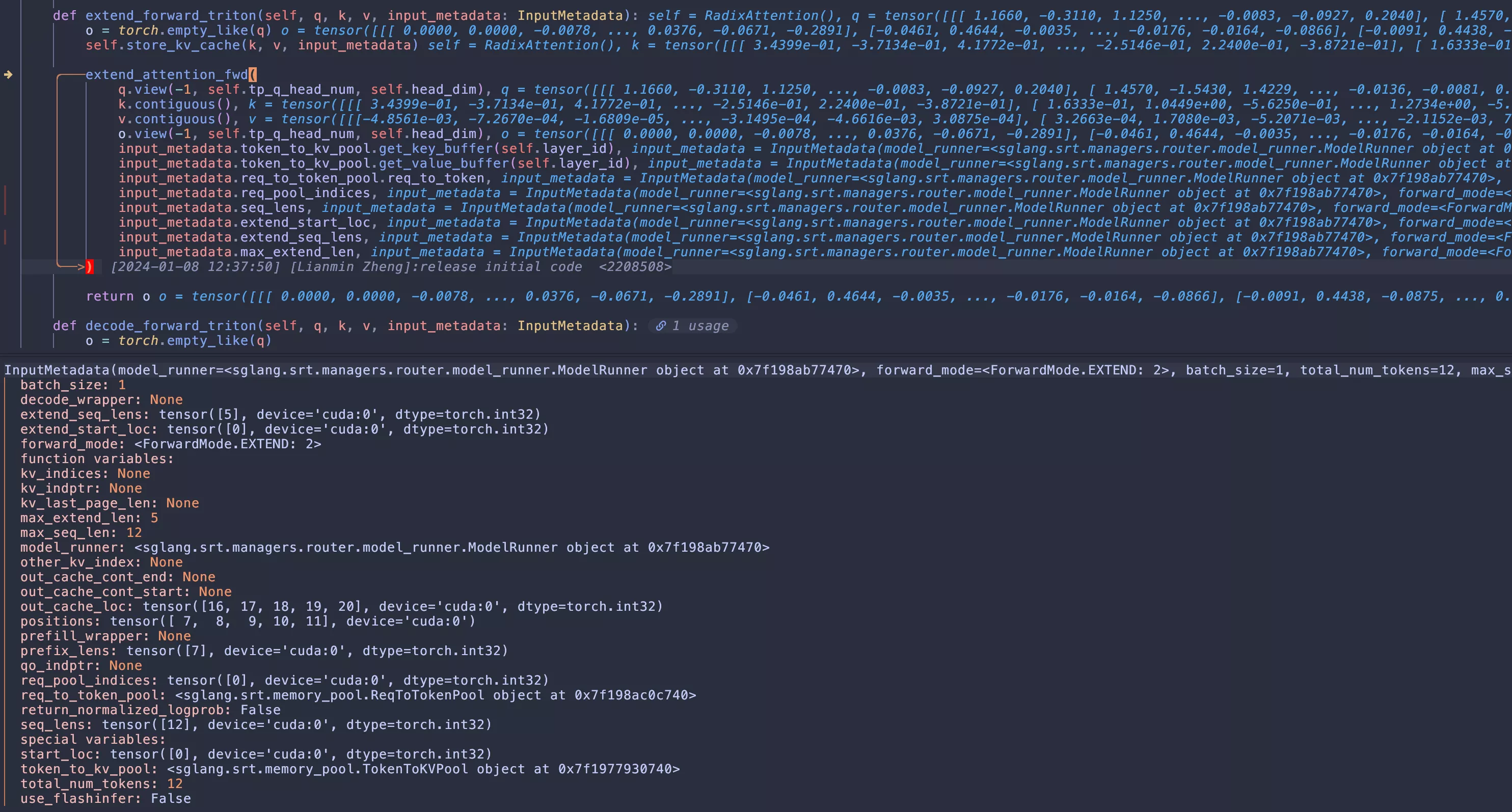
    input_metadata = InputMetadata.create(
        self,
        forward_mode=ForwardMode.EXTEND,
        tp_size=self.tp_size,
        req_pool_indices=req_pool_indices, # [0] 表示请求在req_pool的位置,size是请求数
        seq_lens=seq_lens, # [12] 表示请求的长度,size是请求数
        prefix_lens=prefix_lens, # [7] 表示请求cache tokens个数,size是请求数
        out_cache_loc=out_cache_loc, # [16, 17, 18, 19, 20] 新增加的token的kvcache放的位置,size是batch out tokens个数
        return_normalized_logprob=return_normalized_logprob, # 一般是False,是否需要返回token的logprob
    )
    return self.model.forward(input_ids, input_metadata.positions, input_metadata)

```python
@dataclass
class InputMetadata:
    model_runner: "ModelRunner"
    forward_mode: ForwardMode
    batch_size: int
    total_num_tokens: int
    max_seq_len: int
    req_pool_indices: torch.Tensor
    start_loc: torch.Tensor
    seq_lens: torch.Tensor
    prefix_lens: torch.Tensor
    positions: torch.Tensor
    req_to_token_pool: ReqToTokenPool
    token_to_kv_pool: TokenToKVPool

    # for extend
    extend_seq_lens: torch.Tensor = None
    extend_start_loc: torch.Tensor = None
    max_extend_len: int = 0

    out_cache_loc: torch.Tensor = None
    out_cache_cont_start: torch.Tensor = None
    out_cache_cont_end: torch.Tensor = None

    other_kv_index: torch.Tensor = None
    return_normalized_logprob: bool = False

    def init_extend_args(self):
        self.extend_seq_lens = self.seq_lens - self.prefix_lens
        self.extend_start_loc = torch.zeros_like(self.seq_lens)
        self.extend_start_loc[1:] = torch.cumsum(self.extend_seq_lens[:-1], 0)
        self.max_extend_len = int(torch.max(self.extend_seq_lens))

    @classmethod
    def create(
        cls,
        model_runner,
        tp_size,
        forward_mode,
        req_pool_indices,
        seq_lens,
        prefix_lens,
        out_cache_loc,
        out_cache_cont_start=None,
        out_cache_cont_end=None,
        return_normalized_logprob=False,
    ):
        batch_size = len(req_pool_indices) # 1 就是bs
        start_loc = torch.zeros((batch_size,), dtype=torch.int32, device="cuda")
        start_loc[1:] = torch.cumsum(seq_lens[:-1], dim=0) # seqa_lens tokens个数前缀和
        total_num_tokens = int(torch.sum(seq_lens)) # 12 总tokens个数
        max_seq_len = int(torch.max(seq_lens)) # 12 最大值

        if forward_mode == ForwardMode.DECODE:
            positions = (seq_lens - 1).to(torch.int64)
            other_kv_index = model_runner.req_to_token_pool.req_to_token[
                req_pool_indices[0], seq_lens[0] - 1
            ].item()
        else:
            seq_lens_np = seq_lens.cpu().numpy()
            prefix_lens_np = prefix_lens.cpu().numpy()
            positions = torch.tensor(
                np.concatenate(
                    [
                        np.arange(
                            prefix_lens_np[i],
                            seq_lens_np[i],
                        )
                        for i in range(batch_size)
                    ],
                    axis=0,
                ),
                device="cuda",
            ) # [7,8,9,10,11] positions用于后面推理时的位置编码
            other_kv_index = None

        ret = cls(
            model_runner=model_runner,
            forward_mode=forward_mode,
            batch_size=batch_size,
            total_num_tokens=total_num_tokens,
            max_seq_len=max_seq_len,
            req_pool_indices=req_pool_indices,
            start_loc=start_loc,
            seq_lens=seq_lens,
            prefix_lens=prefix_lens,
            positions=positions,
            req_to_token_pool=model_runner.req_to_token_pool,
            token_to_kv_pool=model_runner.token_to_kv_pool,
            out_cache_loc=out_cache_loc,
            out_cache_cont_start=out_cache_cont_start,
            out_cache_cont_end=out_cache_cont_end,
            return_normalized_logprob=return_normalized_logprob,
            other_kv_index=other_kv_index,
        )

        if forward_mode == ForwardMode.EXTEND:
            ret.init_extend_args()

        ret.use_flashinfer = "flashinfer" in model_runner.model_mode
        if ret.use_flashinfer:
            ret.init_flashinfer_args(tp_size)

        return ret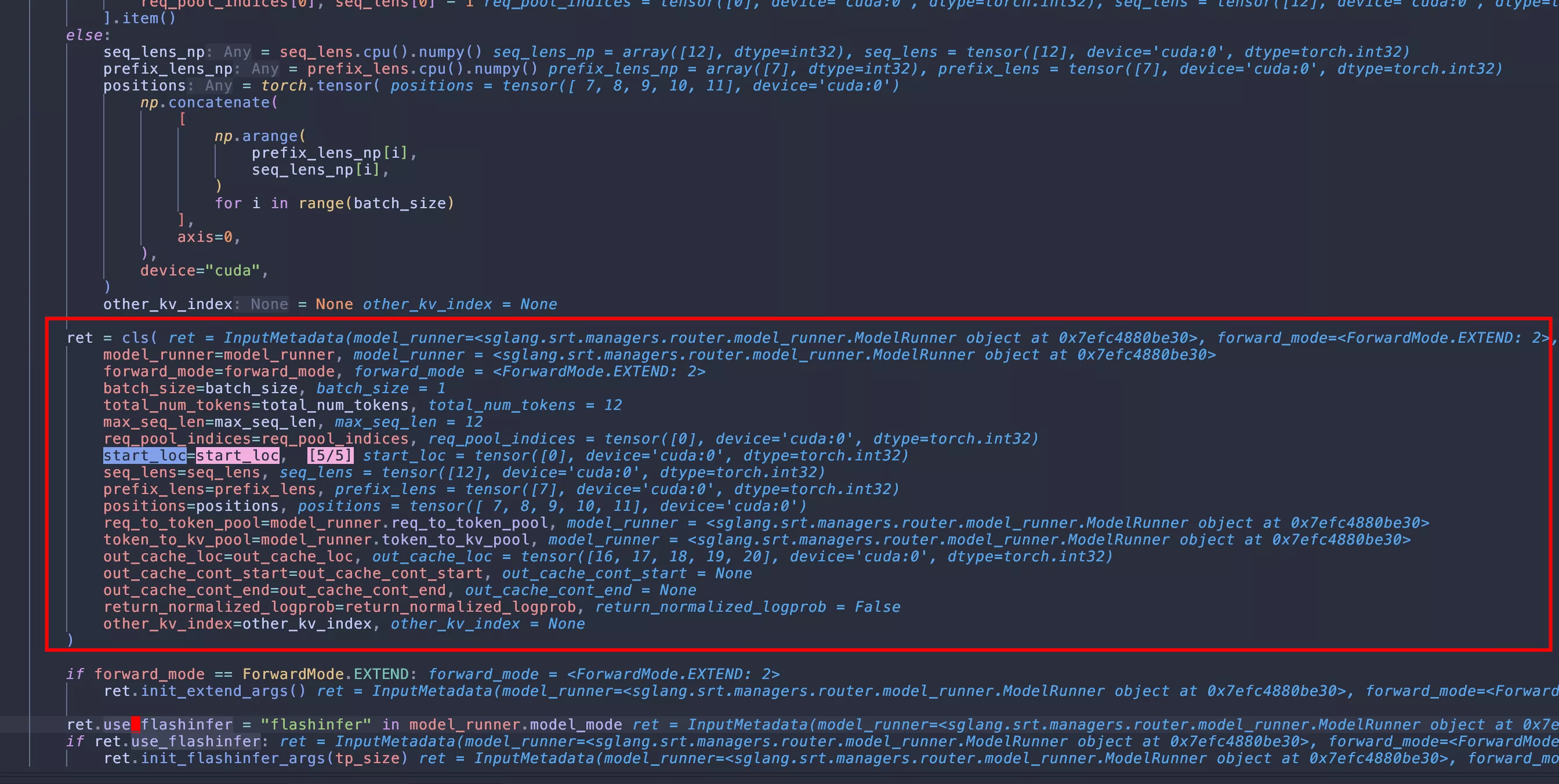
下面举一个两个请求的例子,讲的更清楚一些
prompts = [
    "The capital of France is",
    "Today is a sunny day and I like",
]
cut_num = [3, 4]
reqs = []
for i in range(len(prompts)):
    req = Req(i)
    req.input_ids = tokenizer.encode(prompts[i])[: cut_num[i]]
    req.sampling_params = sampling_params
    reqs.append(req)
两个请求:
- 第一个算上chat_template是6个,这里cache了3个,也就是要extend 3个
- 第二个算上chat_template是10个token,这里cache了4个,也就是要extend 6个
extend代码extend_forward_triton:
def extend_forward_triton(self, q, k, v, input_metadata: InputMetadata):
    o = torch.empty_like(q)
    self.store_kv_cache(k, v, input_metadata)
    extend_attention_fwd(
        q.view(-1, self.tp_q_head_num, self.head_dim),
        k.contiguous(),
        v.contiguous(),
        o.view(-1, self.tp_q_head_num, self.head_dim),
        input_metadata.token_to_kv_pool.get_key_buffer(self.layer_id), # 因为上一步store_kv_cache已经存储了,所以这里的就是完整的kvcache
        input_metadata.token_to_kv_pool.get_value_buffer(self.layer_id), # 因为上一步store_kv_cache已经存储了,所以这里的就是完整的kvcache
        input_metadata.req_to_token_pool.req_to_token,
        input_metadata.req_pool_indices,
        input_metadata.seq_lens,
        input_metadata.extend_start_loc,
        input_metadata.extend_seq_lens,
        input_metadata.max_extend_len,
    )
    return o
首先是创建一个和q相同shape的o预分配好输出
然后是存储kvcache,因为在计算attention之前已经计算好了kv,这里就把kvcache存储到对应的kvpool对应的索引中
pythondef store_kv_cache(self, cache_k, cache_v, input_metadata: InputMetadata): key_buffer = input_metadata.token_to_kv_pool.get_key_buffer(self.layer_id) # 返回的是当前layer的大buffer张量的引用 value_buffer = input_metadata.token_to_kv_pool.get_value_buffer(self.layer_id) # 返回的是当前layer的大buffer张量的引用 if input_metadata.out_cache_loc is not None: key_buffer[input_metadata.out_cache_loc] = cache_k # 在这里对应把内存存储到索引位置就可以了 value_buffer[input_metadata.out_cache_loc] = cache_v # 在这里对应把内存存储到索引位置就可以了调用kernel推理extend_attention_fwd,下面接着讲这个函数
InputMetadata的详细内容:
InputMetadata(model_runner=<sglang.srt.managers.router.model_runner.ModelRunner object at 0x7f599dbebd40>, forward_mode=<ForwardMode.EXTEND: 1>, batch_size=2, total_num_tokens=16, max_seq_len=10, req_pool_indices=tensor([2, 3], device='cuda:0', dtype=torch.int32), start_loc=tensor([0, 6], device='cuda:0', dtype=torch.int32), seq_lens=tensor([ 6, 10], device='cuda:0', dtype=torch.int32), prefix_lens=tensor([3, 4], device='cuda:0', dtype=torch.int32), positions=tensor([3, 4, 5, 4, 5, 6, 7, 8, 9], device='cuda:0'), req_to_token_pool=<sglang.srt.memory_pool.ReqToTokenPool object at 0x7f599fd3d460>, token_to_kv_pool=<sglang.srt.memory_pool.TokenToKVPool object at 0x7f5c2c567b00>, extend_seq_lens=tensor([3, 6], device='cuda:0', dtype=torch.int32), extend_start_loc=tensor([0, 3], device='cuda:0', dtype=torch.int32), max_extend_len=6, out_cache_loc=tensor([ 7,  8,  9, 10, 11, 12, 13, 14, 15], device='cuda:0',\n       dtype=torch.int32), out_cache_cont_start=None, out_cache_cont_end=None, other_kv_index=None, return_normalized_logprob=False, use_flashinfer=False, qo_indptr=None, kv_indptr=None, kv_indices=None, kv_last_page_len=None)
  batch_size: 2
  decode_wrapper: None
  extend_seq_lens: tensor([3, 6], device='cuda:0', dtype=torch.int32)
  extend_start_loc: tensor([0, 3], device='cuda:0', dtype=torch.int32)
  forward_mode: <ForwardMode.EXTEND: 1>
  function variables:
  kv_indices: None
  kv_indptr: None
  kv_last_page_len: None
  max_extend_len: 6
  max_seq_len: 10
  model_runner: <sglang.srt.managers.router.model_runner.ModelRunner object at 0x7f599dbebd40>
  other_kv_index: None
  out_cache_cont_end: None
  out_cache_cont_start: None
  out_cache_loc: tensor([ 7,  8,  9, 10, 11, 12, 13, 14, 15], device='cuda:0',\n       dtype=torch.int32)
  positions: tensor([3, 4, 5, 4, 5, 6, 7, 8, 9], device='cuda:0')
  prefill_wrapper: None
  prefix_lens: tensor([3, 4], device='cuda:0', dtype=torch.int32)
  qo_indptr: None
  req_pool_indices: tensor([2, 3], device='cuda:0', dtype=torch.int32)
  req_to_token_pool: <sglang.srt.memory_pool.ReqToTokenPool object at 0x7f599fd3d460>
  return_normalized_logprob: False
  seq_lens: tensor([ 6, 10], device='cuda:0', dtype=torch.int32)
  special variables:
  start_loc: tensor([0, 6], device='cuda:0', dtype=torch.int32)
  token_to_kv_pool: <sglang.srt.memory_pool.TokenToKVPool object at 0x7f5c2c567b00>
  total_num_tokens: 16
  use_flashinfer: False
调用kernel extend_attention_fwd
详细代码:
def extend_attention_fwd(
    q_extend, # shape: ([9, 32, 64])
    k_extend, # shape: ([9, 4, 64])
    v_extend, # shape: ([9, 4, 64])
    o_extend, # shape: ([9, 32, 64])
    k_buffer, # shape: ([2904745, 4, 64])
    v_buffer, # shape: ([2904745, 4, 64])
    req_to_tokens, # shape: ([363093, 2056])
    b_req_idx, # shape: ([2]) value: [2,3] # 对应到req_to_tokens的索引
    b_seq_len, # shape: ([2]) value: [6,10] # 每个请求的总长
    b_start_loc_extend, # shape: ([2]) value: [0, 3] # 每个请求extend的起始kvcache loc索引
    b_seq_len_extend, # shape: ([2]) value: [3, 6] # 每个请求要计算extend的长度
    max_len_extend, # value: 6
):
    """
    q_extend, k_extend, v_extend, o_extend: contiguous tensors

    k_buffer, v_buffer: (prefix + extend) tensors in mem_manager
    """
    BLOCK_M, BLOCK_N = 128, 128
    Lq, Lk, Lv, Lo = ( # 都是64
        q_extend.shape[-1],
        k_extend.shape[-1],
        v_extend.shape[-1],
        o_extend.shape[-1],
    )
    assert Lq == Lk and Lk == Lv and Lv == Lo
    assert Lq in {16, 32, 64, 128}

    sm_scale = 1.0 / (Lq**0.5) # 提前算出每个头计算qk除上的值 value=0.125
    batch_size, head_num = b_seq_len.shape[0], q_extend.shape[1] # 2, 32
    kv_group_num = q_extend.shape[1] // k_extend.shape[1] # 8=32/4 也就是有4组,每组对应8个q头

    grid = (batch_size, head_num, triton.cdiv(max_len_extend, BLOCK_M)) # grid=(2, 32, 1)
    num_warps = 4 if Lk <= 64 else 8 # num_warps=4
    num_stages = 1

    _fwd_kernel[grid](
        q_extend,
        k_extend,
        v_extend,
        o_extend,
        k_buffer,
        v_buffer,
        req_to_tokens,
        b_req_idx,
        b_seq_len,
        b_start_loc_extend,
        b_seq_len_extend,
        sm_scale,
        kv_group_num,
        q_extend.stride(0),
        q_extend.stride(1),
        k_extend.stride(0),
        k_extend.stride(1),
        v_extend.stride(0),
        v_extend.stride(1),
        o_extend.stride(0),
        o_extend.stride(1),
        k_buffer.stride(0),
        k_buffer.stride(1),
        v_buffer.stride(0),
        v_buffer.stride(1),
        req_to_tokens.stride(0),
        BLOCK_DMODEL=Lq,
        BLOCK_M=BLOCK_M,
        BLOCK_N=BLOCK_N,
        num_warps=num_warps,
        num_stages=num_stages,
)计算triton kernel分析
@triton.jit
def _fwd_kernel(
    Q_Extend, # shape: ([9, 32, 64])
    K_Extend, # shape: ([9, 4, 64])
    V_Extend, # shape: ([9, 4, 64])
    O_Extend, # shape: ([9, 32, 64])
    K_Buffer, # shape: ([2904745, 4, 64])
    V_Buffer, # shape: ([2904745, 4, 64])
    Req_to_tokens, # shape: ([363093, 2056])
    B_req_idx, # shape: ([2]) value: [2,3] # 对应到req_to_tokens的索引
    B_Seq_Len, # shape: ([2]) value: [6,10] # 每个请求的总长
    B_Start_Loc_Extend, # shape: ([2]) value: [0, 3] # 每个请求extend的起始kvcache loc索引
    B_Seq_Len_Extend, # shape: ([2]) value: [3, 6] # 每个请求要计算extend的长度
    sm_scale, # 0.125
    kv_group_num, # 8
    stride_qbs, # 2048
    stride_qh, # 64
    stride_kbs, # 256
    stride_kh, # 64
    stride_vbs, # 256
    stride_vh, # 64
    stride_obs, # 2048
    stride_oh, # 64
    stride_buf_kbs, # 512
    stride_buf_kh, # 64
    stride_buf_vbs, # 512
    stride_buf_vh, # 64
    stride_req_to_tokens_b, # 2056
    BLOCK_DMODEL: tl.constexpr, # 64
    BLOCK_M: tl.constexpr, # 128
    BLOCK_N: tl.constexpr, # 128
):
      # ==================== 程序 ID 初始化 ====================
    # cur_seq: 当前处理的序列 ID(batch 中的第几个样本)
    cur_seq = tl.program_id(0) # 0
    # cur_head: 当前处理的注意力头 ID
    cur_head = tl.program_id(1) # 0
    # cur_block_m: 当前处理的 Q 块 ID(每个块包含 BLOCK_M 个 token)
    cur_block_m = tl.program_id(2)
    # cur_kv_head: 当前 KV 头 ID(用于 GQA/MQA,计算当前 Q 头对应的 KV 头)
    cur_kv_head = cur_head // kv_group_num

    # ==================== 加载序列长度信息 ====================
    # cur_seq_len: 当前序列的总长度(prefix + extend)
    cur_seq_len = tl.load(B_Seq_Len + cur_seq) # 6
    # cur_seq_len_extend: 当前序列的 extend 部分长度(新生成的 token 数)
    cur_seq_len_extend = tl.load(B_Seq_Len_Extend + cur_seq) # 3
    # cur_seq_len_prefix: 当前序列的 prefix 部分长度(历史 KV 缓存中的 token 数)
    cur_seq_len_prefix = cur_seq_len - cur_seq_len_extend # 3

    # ==================== 加载位置索引信息 ====================
    # cur_seq_prefix_start_in_loc: prefix 部分的起始位置(固定为 0)
    cur_seq_prefix_start_in_loc = 0
    # cur_seq_extend_start_contiguous: extend 部分在连续内存中的起始位置
    cur_seq_extend_start_contiguous = tl.load(B_Start_Loc_Extend + cur_seq) # 0
    # cur_batch_req_idx: 当前序列在 batch 中的请求 ID
    cur_batch_req_idx = tl.load(B_req_idx + cur_seq) # 2

    # ==================== 计算 Q 矩阵的偏移和加载 Q ====================
    # offs_d: 生成维度索引 [0, 1, 2, ..., BLOCK_DMODEL-1]
    offs_d = tl.arange(0, BLOCK_DMODEL)
    # offs_m: 生成 M 维度索引 [0, 1, 2, ..., BLOCK_M-1]
    offs_m = tl.arange(0, BLOCK_M)
    # mask_m: 有效位置掩码,防止访问超出序列长度
    mask_m = (cur_block_m * BLOCK_M + offs_m) < cur_seq_len_extend
    # offs_q: 计算 Q 矩阵的内存偏移
    #   - cur_seq_extend_start_contiguous + cur_block_m * BLOCK_M + offs_m[:, None]: token 维度位置
    #   - stride_qbs: batch 维度的步长
    #   - cur_head * stride_qh: head 维度的步长
    #   - offs_d[None, :]: 特征维度偏移
    offs_q = (
        (cur_seq_extend_start_contiguous + cur_block_m * BLOCK_M + offs_m[:, None])
        * stride_qbs
        + cur_head * stride_qh
        + offs_d[None, :]
    )
    # q: 加载 Q 矩阵的当前块,形状为 [BLOCK_M, BLOCK_DMODEL]
    q = tl.load(Q_Extend + offs_q, mask=mask_m[:, None], other=0.0)

    # ==================== Stage 1: 计算与 prefix 部分的注意力 ====================
    # offs_n: 生成 N 维度索引 [0, 1, 2, ..., BLOCK_N-1],用于 K/V 的块迭代
    offs_n = tl.arange(0, BLOCK_N)

    # acc: 累加器,存储加权后的 V 值和,形状 [BLOCK_M, BLOCK_DMODEL]
    acc = tl.zeros([BLOCK_M, BLOCK_DMODEL], dtype=tl.float32)
    # deno: 分母累加器,存储 softmax 分母,形状 [BLOCK_M]
    deno = tl.zeros([BLOCK_M], dtype=tl.float32)
    # e_max: 用于存储历史块的最大值
    e_max = tl.zeros([BLOCK_M], dtype=tl.float32) - float("inf")

    # 遍历 prefix 部分的所有 KV 块(每次处理 BLOCK_N 个 token)
    for start_n in range(0, cur_seq_len_prefix, BLOCK_N):
        # 确保 start_n 是 BLOCK_N 的倍数(Triton 优化要求)
        start_n = tl.multiple_of(start_n, BLOCK_N)
        # mask_n: prefix 部分的有效位置掩码
        mask_n = (start_n + offs_n) < cur_seq_len_prefix
        # offs_b_loc_prefix: 计算 Req_to_tokens 表的偏移
        #   - cur_batch_req_idx * stride_req_to_tokens_b: batch 偏移
        #   - cur_seq_prefix_start_in_loc + start_n + offs_n: token 位置
        offs_b_loc_prefix = cur_batch_req_idx * stride_req_to_tokens_b + (
            cur_seq_prefix_start_in_loc + start_n + offs_n
        )
        # offs_kv_loc: 从 Req_to_tokens 表加载实际的 KV 缓存位置索引
        #   Req_to_tokens 表将逻辑 token 位置映射到物理 KV 缓存位置(因为 KV 缓存是非连续的)
        offs_kv_loc = tl.load(Req_to_tokens + offs_b_loc_prefix, mask=mask_n, other=0)

        # load k in transposed way
        # offs_buf_k: 计算 K_Buffer 的内存偏移
        #   - offs_kv_loc[None, :] * stride_buf_kbs: 根据物理位置索引计算 batch 维度偏移
        #   - cur_kv_head * stride_buf_kh: head 维度偏移
        #   - offs_d[:, None]: 特征维度偏移(转置布局)
        offs_buf_k = (
            offs_kv_loc[None, :] * stride_buf_kbs
            + cur_kv_head * stride_buf_kh
            + offs_d[:, None]
        )
        # k: 加载 K 矩阵的当前块,形状为 [BLOCK_DMODEL, BLOCK_N](转置布局)
        k = tl.load(K_Buffer + offs_buf_k, mask=mask_n[None, :], other=0.0)

        # qk: 初始化 QK 注意力分数矩阵,形状 [BLOCK_M, BLOCK_N]
        qk = tl.zeros([BLOCK_M, BLOCK_N], dtype=tl.float32)
        # qk += tl.dot(q, k): 计算 Q 和 K 的点积(矩阵乘法)
        qk += tl.dot(q, k)
        # qk *= sm_scale: 应用缩放因子 1/sqrt(d_k),防止 softmax 梯度消失
        qk *= sm_scale
        # qk = tl.where(...): 应用掩码,将无效位置设为负无穷
        # 在这里无效位置就是超出边界的位置,会设置成-inf,(e^(-inf)=0)就会是0
        qk = tl.where(mask_m[:, None] & mask_n[None, :], qk, float("-inf"))

        # ==================== Online Softmax 更新 ====================
        # n_e_max: 更新后的最大值,取当前块的最大值和历史最大值的较大者
        # tl.max(qk,1) 对qk在第一维取最大值,输出维度为[BLOCK_M]
        n_e_max = tl.maximum(tl.max(qk, 1), e_max)
        # re_scale: 重缩放因子,用于将历史累加值缩放到新的最大值基准
        re_scale = tl.exp(e_max - n_e_max)
        # p: 计算 softmax 概率,exp(qk - max)
        p = tl.exp(qk - n_e_max[:, None])
        # deno: 更新分母累加器,历史值重缩放后加上当前块的概率和
        deno = deno * re_scale + tl.sum(p, 1)

        # offs_buf_v: 计算 V_Buffer 的内存偏移
        #   - offs_kv_loc[:, None] * stride_buf_vbs: 根据物理位置索引计算 batch 维度偏移
        #   - cur_kv_head * stride_buf_vh: head 维度偏移
        #   - offs_d[None, :]: 特征维度偏移
        offs_buf_v = (
            offs_kv_loc[:, None] * stride_buf_vbs
            + cur_kv_head * stride_buf_vh
            + offs_d[None, :]
        )
        # v: 加载 V 矩阵的当前块,形状为 [BLOCK_N, BLOCK_DMODEL]
        v = tl.load(V_Buffer + offs_buf_v, mask=mask_n[:, None], other=0.0)
        # p = p.to(v.dtype): 将概率矩阵转换为 V 的数据类型(通常是 float16/bfloat16)
        p = p.to(v.dtype)
        # acc: 更新分子累加器,历史值重缩放后加上当前块的加权和 (p @ v)
        acc = acc * re_scale[:, None] + tl.dot(p, v)

        # e_max = n_e_max: 更新最大值为当前块的最大值
        e_max = n_e_max

    # ==================== Stage 2: 计算 extend 部分的因果注意力(三角形掩码)====================
    # cur_block_m_end: 当前块的实际结束位置,防止超出序列长度
    cur_block_m_end = tl.minimum(cur_seq_len_extend, (cur_block_m + 1) * BLOCK_M)
    # 遍历 extend 部分的所有 KV 块(每次处理 BLOCK_N 个 token)
    for start_n in range(0, cur_block_m_end, BLOCK_N):
        # 确保 start_n 是 BLOCK_N 的倍数
        start_n = tl.multiple_of(start_n, BLOCK_N)
        # mask_n: extend 部分的有效位置掩码
        mask_n = (start_n + offs_n) < cur_block_m_end

        # load k in transposed way
        # offs_k: 计算 K_Extend 的内存偏移(extend 部分是连续存储的)
        offs_k = (
            (cur_seq_extend_start_contiguous + start_n + offs_n[None, :]) * stride_kbs
            + cur_kv_head * stride_kh
            + offs_d[:, None]
        )
        # k: 加载 K_Extend 的当前块,形状为 [BLOCK_DMODEL, BLOCK_N]
        k = tl.load(K_Extend + offs_k, mask=mask_n[None, :], other=0.0)

        # qk: 初始化 QK 注意力分数矩阵
        qk = tl.zeros([BLOCK_M, BLOCK_N], dtype=tl.float32)
        # qk += tl.dot(q, k): 计算 Q 和 K 的点积
        qk += tl.dot(q, k)
        # qk *= sm_scale: 应用缩放因子
        qk *= sm_scale
        # mask_causual: 因果掩码,确保每个位置只能看到之前的位置(三角形掩码)
        #   (cur_block_m * BLOCK_M + offs_m[:, None]) >= (start_n + offs_n[None, :])
        #   表示当前 Q 的 token 位置必须 >= K 的 token 位置
        mask_causual = (cur_block_m * BLOCK_M + offs_m[:, None]) >= (
            start_n + offs_n[None, :]
        )
        # mask_causual &= mask_m[:, None] & mask_n[None, :]: 与有效位置掩码取交集
        mask_causual &= mask_m[:, None] & mask_n[None, :]
        # qk = tl.where(...): 应用因果掩码,将未来位置设为负无穷
        qk = tl.where(mask_causual, qk, float("-inf"))

        # ==================== Online Softmax 更新(与 Stage 1 相同)====================
        # n_e_max: 更新后的最大值
        n_e_max = tl.maximum(tl.max(qk, 1), e_max)
        # re_scale: 重缩放因子
        re_scale = tl.exp(e_max - n_e_max)
        # p: 计算 softmax 概率
        p = tl.exp(qk - n_e_max[:, None])
        # deno: 更新分母累加器
        deno = deno * re_scale + tl.sum(p, 1)

        # offs_v: 计算 V_Extend 的内存偏移
        offs_v = (
            (cur_seq_extend_start_contiguous + start_n + offs_n[:, None]) * stride_vbs
            + cur_kv_head * stride_vh
            + offs_d[None, :]
        )
        # v: 加载 V_Extend 的当前块,形状为 [BLOCK_N, BLOCK_DMODEL]
        v = tl.load(V_Extend + offs_v, mask=mask_n[:, None], other=0.0)
        # p = p.to(v.dtype): 类型转换
        p = p.to(v.dtype)
        # acc: 更新分子累加器
        acc = acc * re_scale[:, None] + tl.dot(p, v)

        # e_max = n_e_max: 更新最大值
        e_max = n_e_max

    # ==================== 输出结果 ====================
    # offs_o: 计算输出矩阵 O_Extend 的内存偏移
    offs_o = (
        (cur_seq_extend_start_contiguous + cur_block_m * BLOCK_M + offs_m[:, None])
        * stride_obs
        + cur_head * stride_oh
        + offs_d[None, :]
    )
    # tl.store: 存储最终结果,acc / deno[:, None] 完成 softmax 归一化
tl.store(O_Extend + offs_o, acc / deno[:, None], mask=mask_m[:, None])在上面的代码中,几个关键参数和矩阵tiling思路:
- 注意拆分的grid,有三个维度
- 第一维是batchsize,也就是第几个请求
- 第二维是head头数,也就是第几个头,每8个头对应到一个相同的kv
- 第三维是tokens数,也就是200个tokens会被拆分成两个cdiv(200,128)
- BLOCK_M 是按照tokens个数来算的,也就是比如有200个token,那么会被拆成两次BLOCK_M
- BLOCK_DMODEL 是按照单个head的隐含层维度固定下来的,对于当前模型就是固定64
因此最后的q矩阵的维度是[BLOCK_M, BLOCK_DMODEL]
在计算部分,拆分成了两个部分,第一个是q和prefix的kv计算,第二个q和extend的kv计算, 拆成两个是因为两个部分的计算特性不一样,prefix在内存中是可能不连续的,而extend是连续(分配的时候就保证连续)
首先是q和prefix的kv进行计算: k的维度是:[BLOCK_DMODEL, BLOCK_N],这里的BLOCK_N是按照prefix的总的tokens数进行切分,只是上面的配置成BLOCK_M和BLOCK_N是一样的
onlinesoftmax:
acc是分子,每一步都在根据当前的最大值进行更新,累加是因为做了矩阵分块,所以是按照矩阵分块进行最终的矩阵乘加进行的累加。
deno是分母,这个值是不断更新的,在遍历完最后一个块完成更新,这个值本身是在softmax中,但是因为对于每个token对应的hidden state,只会有一个值,所以先进行了乘上v,最后再把分子除上了这个deno分母,也不影响最终的计算结果。
总之当前的online softmax好处是实时更新,永远不需要分配一个和矩阵size相同的临时激活值变量。在迭代完也就是完成了最终的计算
mask实现
在上面的代码中,分成了两个stage,一个是prefix一个是extend,两个stage实现的mask不同
- 对于第一个prefix,mask的作用只是为了范围分块超出索引边界,对于prefix的因果是全部都要计算的
- 对于第二个extend,mask就需要根据位置进行实际的掩码索引了,
mask_causual = (cur_block_m * BLOCK_M + offs_m[:, None]) >= (
    start_n + offs_n[None, :]
)
mask_causual = (cur_block_m * BLOCK_M + offs_m[:, None]) >= (
    start_n + offs_n[None, :]
)
这段代码相比第一个prefix,多了第一句的q的位置需要大于等于k的位置